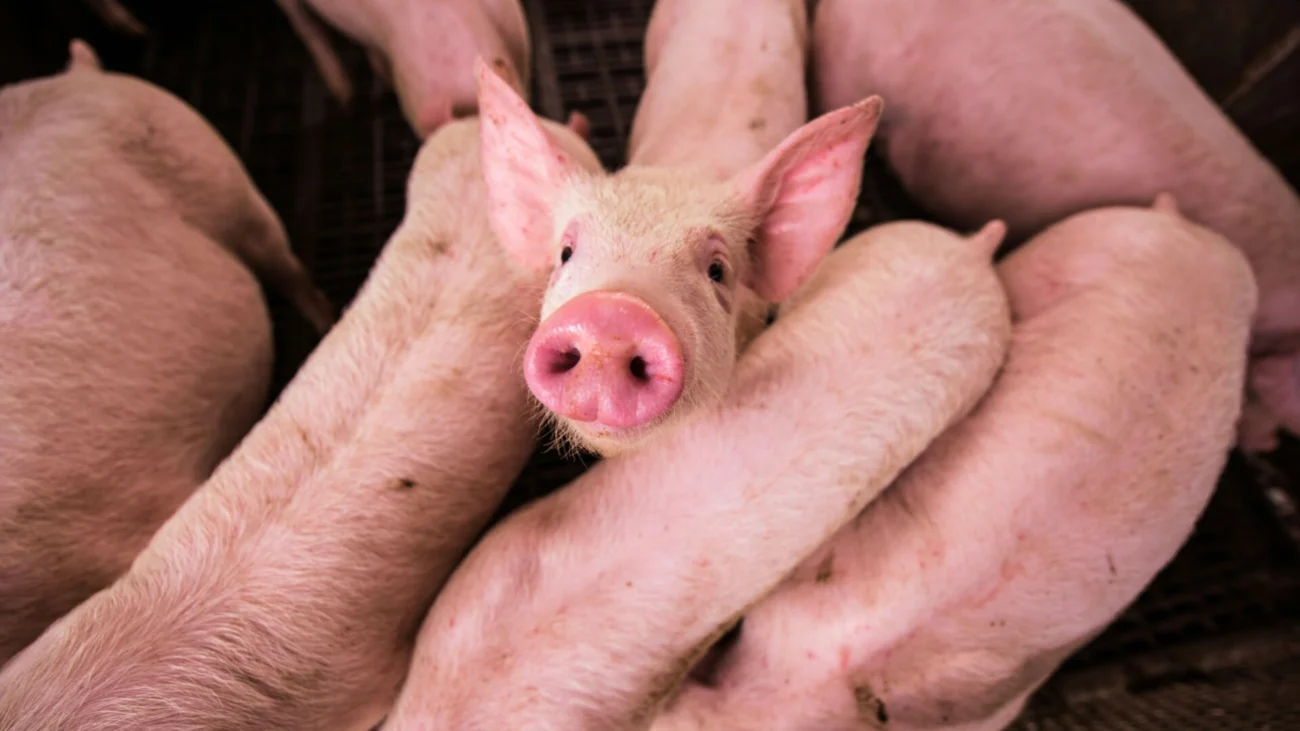

More than 30 years after the EU first banned routine tail docking (the painful removal of tails, typically without anaesthetics) on piglets, only Finland and Sweden comply with the law. Across the rest of the EU, an average of 77 % of piglets are still routinely mutilated – with figures hitting 95 % to 100 % in top producers like Germany, the Netherlands, Italy, Spain and Denmark. Yet Common Agricultural Policy (CAP) funding continues to flow to these producers, illustrating how deeply non-compliance has become institutionalised.
This isn’t only an animal welfare crisis; it’s a law enforcement failure and a threat to human health, as poor animal welfare compromises animal immunity and fuels systemic antimicrobial overuse – a crisis projected to contribute to 390 000 annual deaths in the EU through antibiotic-resistant bacteria.
As the post-2027 CAP reform approaches and 25 of 27 EU Member States continue to breach animal welfare law without facing consequences, the question that needs to be urgently answered is: how much longer will the EU ignore its own rules?
When EU law becomes optional
Since 1994, EU law has prohibited routine tail docking on piglets through ‘the Pig Directive’. In intensive commercial farming, tails are removed to prevent tail biting – where pigs chew on each other’s tails. However, tail biting is a behavioural pathology only triggered when pigs are confined to intensive, stressful, and overcrowded indoor environments lacking space and stimulation, driving these intelligent animals to cannibalism.
By design, the directive requires farmers to address these systemic environmental flaws rather than removing piglets’ tails to hide the symptoms of poor welfare.
While most EU legislation sees higher compliance over time, pig welfare has stagnated. This stagnation has persisted for over 30 years despite repeated warnings from civil society and with full awareness from both the European Parliament (EP) and Commission.
A breakdown of institutional credibility
The three-decade enforcement vacuum has hollowed out the principle of uniform rights and institutional credibility. Because directives rely on Member States for transposition and domestic monitoring, their efficacy relies heavily on the integrity of National Competent Authorities (NCAs). When NCAs fail to enforce EU law, the practical value of EU law collapses.
While the Commission holds the ultimate treaty power to rectify these failures via infringement procedures, even this mechanism of last resort has failed. When the Danish Animal Welfare Society submitted an infringement complaint in 2012, the Commission decided that despite EU law not being implemented properly, it wouldn’t launch infringement proceedings. It opted instead to rely on soft-law guidelines and never-developed e-learning tools. Although the EP’s Petitions Committee (PETI) urged a much bolder response, the Commission stood firm, signalling to the pig meat industry that violating EU law doesn’t result in any real consequences.
This encouraged systemic infringement. In January 2025, the Commission’s DG SANTE decided to investigate another civil complaint regarding Danish non-compliance. Yet a year and a half later, in April 2026, a report by the Danish National Auditors issued a blistering critique of the country’s continued failure to enforce animal welfare law. The auditors reconfirmed a regulatory system riddled with loopholes. Violating producers could simply reset their records by changing their corporate registration numbers.
Even where violations were formally logged, authorities applied only the mildest possible penalties and only 4 % of legal breaches were ever referred to the police. To top all that off, not a single producer was excluded from receiving CAP funding.
Investigative journalism has exposed an even darker reality. TV2 revealed that while the Danish NCA only inspects 10 % of farms each year, over 50 % of inspections document untreated diseases amongst the animals, 40 % find severe conditions requiring euthanasia and 25 % find untreated tail biting on already docked tails. Professional vets carrying out the inspections were systematically pressured by the NCA to downgrade legal infractions from ‘police arrests’ to minor ‘notions’, meaning no legal penalties for perpetrators, with whistleblowers dismissed when speaking up.
Alas, the Danish case isn’t rare; it’s only one example of how 25 Member States neutralise European law through tolerating non-compliance.
The CAP paradox and the ‘One Health’ fallacy
Compliance with EU animal welfare is a legally binding prerequisite for receiving CAP financial support. CAP funding currently flows through direct payments (EAGF), rural development programmes (EAFRD) and specialised animal welfare initiatives.
Paradoxically, these funds are structurally decoupled from actual compliance. A recent EUR 20 million Danish Aid Package to reduce tail biting highlighted that animal welfare remains so poor that the Commission must fund remedies for symptoms (biting) that farmers are already illegally masking. By decoupling investments and applying minimal to zero budgetary deductions to non-compliant Member States, the EU has spent three decades subsidising an industry that operates in – and profits from – violations of EU animal welfare law.
Beyond endangering animals, this unethical subsidisation also directly endangers humans. The ‘One Health’ framework highlights that human health, animal welfare and environmental protection are fundamentally intertwined. Funding and tolerating near-total non-compliance in a sector confining 132 million pigs shatters this. Poor animal welfare drastically compromises their immune systems and reinforces antimicrobial usage (AMU) in commercial farming, which then fuels the rapid acceleration of antimicrobial resistance.
The consequences are arguably dire. Recent research warns of a global 30 % increase in AMU by 2040. Meanwhile, there’s been a four-percentage-point increase in antibiotic-resistant bacteria in pork between 2021 and 2023. Today, over 35 000 people in the EU die annually from infections caused by antibiotic-resistant bacteria – a figure projected to skyrocket to 390 000 annual deaths by 2050.
The Commission cannot continue to treat the Pig Directive as an optional checkbox. In the approaching post-2027 CAP reform, the EU must ‘un-tick’ subsidies for non-compliant Member States and deploy sanctions against negligent Member States and their NCAs. Missing this opportunity to protect the pigs, safeguard public health and restore institutional credibility would only further destroy the EU’s image as a guardian of animal welfare.
Ultimately, this will reduce the One Health framework to hollow words on an empty page – leaving European taxpayers to pay the bill for tortured animals, the continued dismissal of their rights under EU law, and an easily avoidable future health crisis.