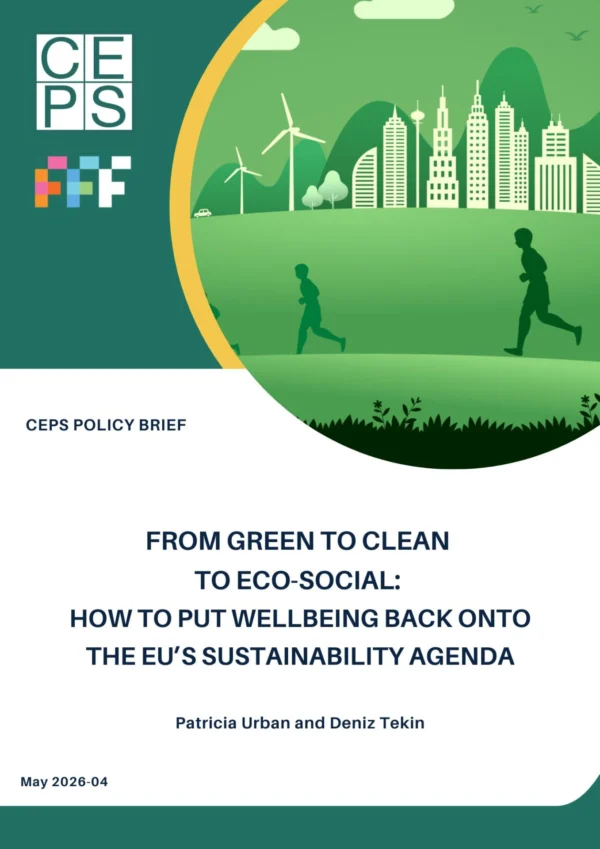


Wellbeing has always been a cornerstone of the European project. Since the Green Deal and the Just Transition Mechanism, it has also been central to the EU’s sustainability agenda. The 8th Environmental Action Programme explicitly calls for establishing a wellbeing economy within planetary boundaries. Arguably, wellbeing should be part of the EU’s sustainability ambitions, given the strong inequality dimension of climate change and the fact that human wellbeing cannot exist without planetary wellbeing.
But wellbeing is hardly at the forefront of today’s EU policy discourse. The Commission’s main geopolitical concern – competitiveness – has moved beyond economic or trade policy and permeates its current flagship sustainability strategy, the Clean Industrial Deal (itself borne from the Commission’s competitiveness compass).
In this policy brief, we discuss how the Clean Industrial Deal frames wellbeing considerations and how this has shifted compared to the Green Deal. While we find continuity in some areas (e.g. on re-skilling workers), there is a narrower focus on providing jobs as a means of supporting economic growth in European industries, rather than protecting people from negative impacts of the transition across different dimensions. Existing inequalities and systemic changes are also largely overlooked.
Such changes would require moving beyond GDP growth as the yardstick for success. Competitiveness could instead be measured in terms of sustainable and inclusive wellbeing – something the EU is uniquely well positioned to deliver. To re-anchor wellbeing in the EU’s sustainability agenda, we suggest (1) introducing eco-social conditionalities to public funding under the CID, (2) including wellbeing indicators in the CID’s Fair Transition Observatory, and (3) investing in modelling of alternative economic futures beyond GDP to inform future policymaking.
This paper was prepared in the context of the MultiFutures project, which has received funding from the European Union’s Horizon Europe research and innovation programme under grant agreement No 101121353.