
Like every year, 25 November marked the International Day for the Elimination of Violence Against Women. A date that should spark reflection, not complacency. While the EU and some Member States have achieved some recent milestones on women’s rights – such as the EU Directive on combating violence against women, the European Citizens’ Initiative ‘My Voice, My Choice’ reaching the Commission and Parliament, and France adding consent to its rape law after the Gisèle Pelicot case – others are moving in the opposite direction.
Latvia, for example, is planning to withdraw from the Istanbul Convention, potentially becoming ‘the first EU country to leave an international human rights treaty’.
Despite being delayed until next year, the Latvian proposal to quit is alarming and fits neatly into a worrying global pattern, namely the politicisation of women’s rights and the ongoing challenge of keeping women’s rights above and beyond political fights.
Why Istanbul matters
To understand the gravity of Latvia withdrawing, it’s worth remembering what the Istanbul Convention represents. Adopted in 2011 and ratified by the EU in June 2023 (and by Latvia in January 2024), the Convention is the first legally binding European instrument that aims to protect women from all forms of violence and discrimination, which is clearly stated in its very first article.
This broader framework isn’t abstract – what it seeks to address is visible and deeply troubling. In fact, according to the latest EU survey on gender-based violence, nearly one in three women aged 18 to 74 have experienced physical or sexual violence in adulthood.
Among women who have had a partner, almost 18 % report having suffered physical or sexual violence from that partner. Violence outside the home is also widespread: about one in five women have faced physical (including verbal threats) or sexual violence by someone other than a partner, and roughly one in eight have experienced sexual violence from a non-partner – including rape.
These figures make it painfully clear that gender-based violence is not a marginal issue. Rather, it’s still a common reality across all EU Member States. Slow progress only reinforces how important it is to preserve and strengthen every tool available to protect women. Against this backdrop, Latvia cannot afford to walk away.
Is protecting women’s rights really ‘radical’?
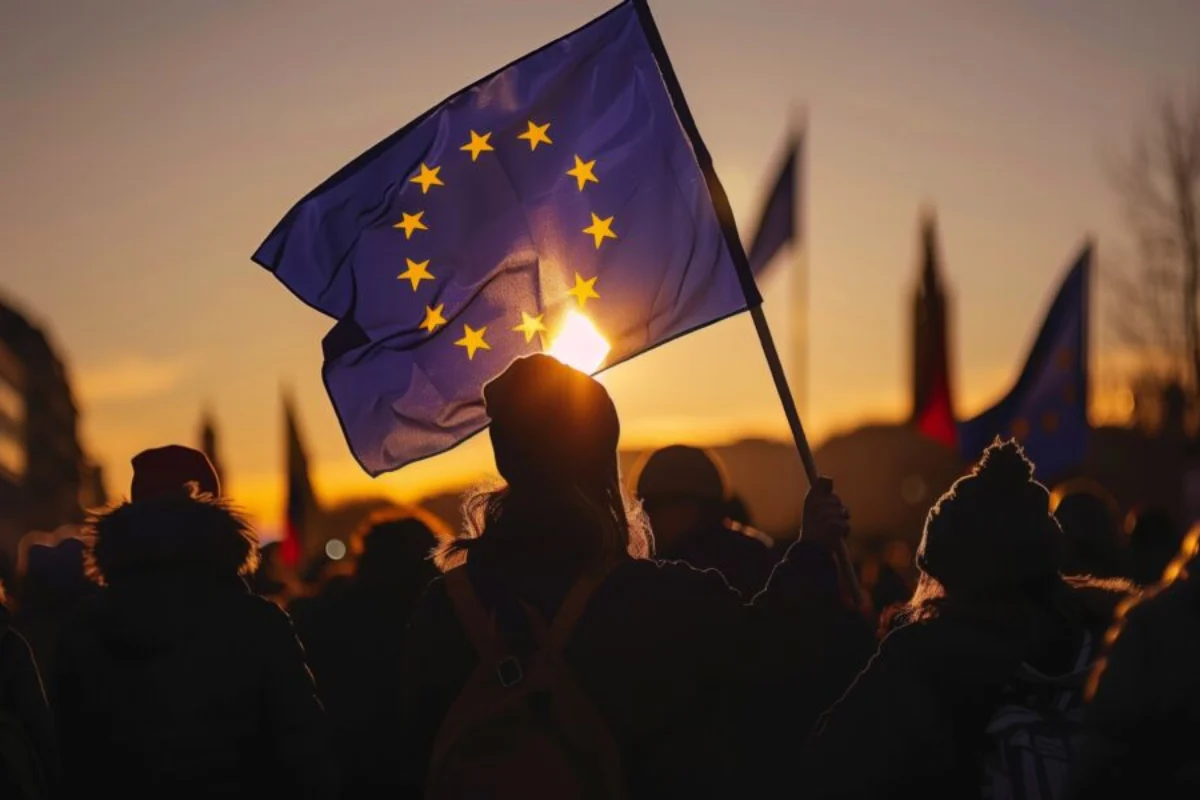
The impact of this proposal has been felt on the streets. Thousands of demonstrators united in Riga on 30 October to protest the decision taken by the Saeima, the Latvian Parliament, which was supported by 56 lawmakers, opposed by 32, and saw two abstentions. Among their reasons, those who support withdrawing claim that the Convention supposedly promotes ‘radical feminism based on the ideology of gender’, thus undermining traditional family roles and values. They also suggest that the existing national legal framework is enough to protect women from gender-based violence.
It’s important to unpack these arguments. Radical feminism is a feminist perspective that emerged in the late 1960s, asserting that patriarchy is the fundamental system of power that oppresses women and that achieving gender equality requires dismantling patriarchal institutions rather than reforming them. The ‘ideology of gender’ (or ‘gender ideology’) is a pejorative term used by conservative movements to define a belief system that views gender as a social and cultural construct rather than a fixed biological fact, mainly adopted to oppose feminist theories that treat gender as a social construct.
The association between the Istanbul Convention and ‘radical feminism’ is misleading, given the treaty’s primary purpose is to protect women from violence. Presenting such protections as ‘radical’ ignores their alignment with the EU’s founding values under Article 2 TEU.
It’s not just Latvia – it’s a global (and growing) political trend
What’s happening in Latvia isn’t an isolated case. Around the world, measures to advance women’s rights have been diverted into political confrontations and culture wars, reducing them to issues that can be cast aside when they no longer serve the interests of the politicians in power.
We’ve seen this with Javier Milei, who swiftly dissolved Argentina’s Ministry of Women, Gender and Diversity – a body established under the previous Fernández administration – immediately after being officially sworn in. Then came the Trump administration, cutting aid and funding, affecting women’s rights organisations worldwide, and abolishing federal support for DEI programmes.
Taking all this into account, Latvia’s decision is even more significant. It’s not just a local controversy; it’s a worrying confirmation of how fragile women’s protections can become when political agendas override the commitment to fundamental rights.
Rights over rhetoric in the next Gender Equality Strategy
The problem lies in how women’s rights are often perceived as either negotiable or a secondary concern. If they’re framed in terms of ideology or partisan debate, protections can be undermined whenever political power shifts.
Addressing gender-based violence cannot be reduced to a clash of political ideologies or moral arguments. At its core, this isn’t about ‘taking sides’ but about recognising that no one should ever have to negotiate their right to live freely from harm.
Ahead of the next European Gender Equality Strategy for 2026-2030, the challenge of the far right and certain transnational networks that are threatening women’s rights and gender equality were both highlighted in the Report on the Gender Equality Strategy 2025, adopted by the European Parliament on 13 November. Set to be adopted early next year after extensive consultations, the upcoming strategy offers a crucial opportunity to reaffirm that gender-based violence cannot depend on who holds power or on shifting political tides.
But to be really ‘ambitious’, any new strategy must approach gender-based violence as a violation of fundamental human rights and a threat to public safety, thus depoliticising the issue – so that protecting women becomes a universal, non-negotiable responsibility. For everyone.