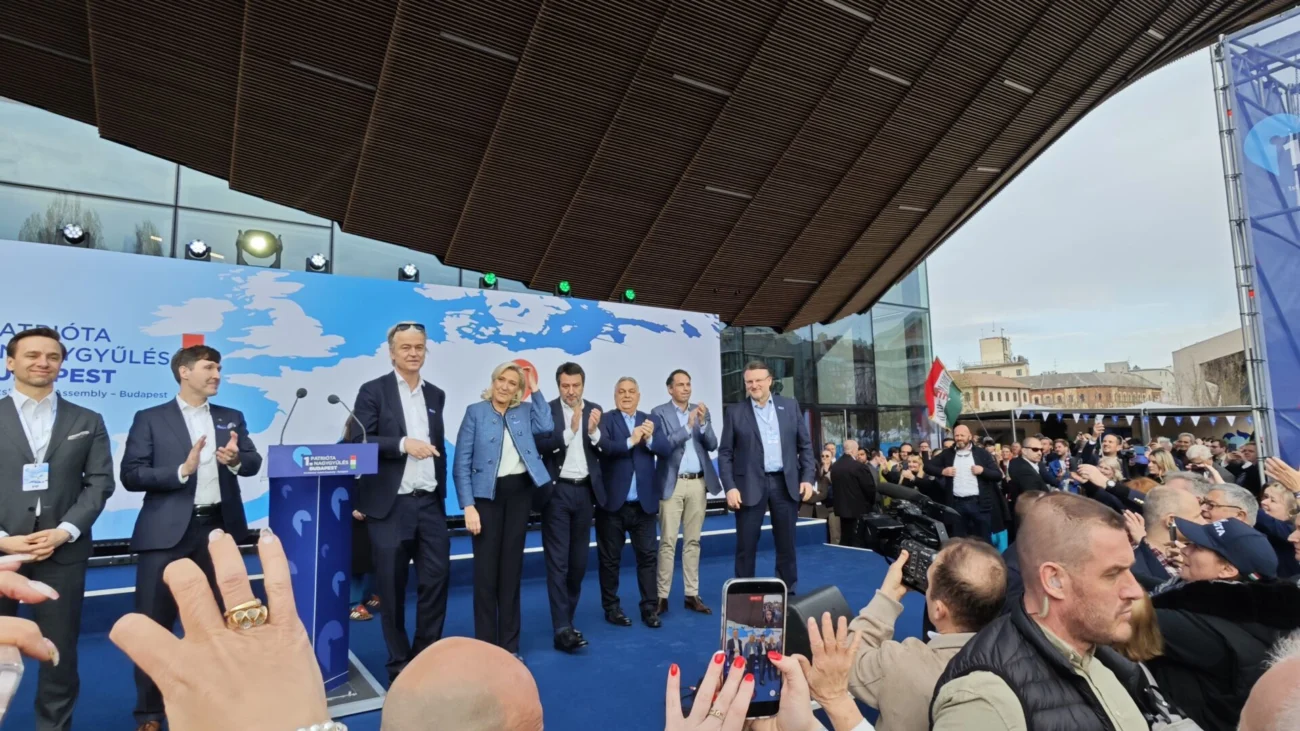

At first glance, radical-right groups like the Patriots for Europe (PfE) are full of contradictions – they hold pan-European rallies yet would dismantle the EU in its current form; they’re highly active in the European Parliament (EP) yet disdain the institution; and they seek alliances with MAGA groups, though they’ve traditionally opposed US administrations.
But once the radical right’s own theories of sovereignty, democracy and politics are considered, unpacking these paradoxes becomes easier. And understanding them reveals that the radical right is more than a simple byproduct of the EU’s past mistakes… but rather a coherent political force that will continue to shape European politics for the foreseeable future.
Paradox 1 – united by Euroscepticism
When looking at the radical right’s many rallies in Europe, particularly those held by the Patriots for Europe (PfE), one discovers that their national leaders stand united on a common stage, to deliver a common message, to a common European audience – something we’d expect federalists to do, not nationalists looking to deconstruct the EU.
The elephant in the room is that the Patriots are vehemently against European integration in its current form and – as stated in The Great Reset, recently published by a think tank aligned with their thinking – would rather return the EU to its pre-1957 model, presumably gutting most EU law. This offers one of the clearest shared visions of the EU’s ideal end state from any EP group… even if that means dismantling it.
To add to the contradiction, the nature of nationalist parties inherently makes reaching common policy positions challenging. For example, their economic positions strongly deviate from party to party.
That’s why it shouldn’t come as a surprise that the Patriots reject most reforms but rarely offer alternatives, well summed up by one of their catchphrases: ‘no migration, no gender, no war.’
It’s a mistake, however, to assume that radical right parties are merely acting opportunistically to further their own domestic agenda or that their unity is doomed to fall apart as soon as national interests start diverging. Such moments have already come and gone, without significantly affecting their cohesion.
Rather, their rhetoric is underpinned by a coherent political philosophy that reinforces their unity – especially through Euroscepticism.
Paradox 2 – inside the EP but against the EP
A Patriot MEP explaining how sovereignty and democracy should be defined would likely raise plenty of eyebrows among EU officials but it would also help explain why the Patriots are very active in the EP despite often treating it as illegitimate.
The EU’s legitimacy rests on the (partly unresolved) understanding that sovereignty can be lent, shared or even transferred. In trade policy, the EU exercises exclusive competence based on a mandate from the Member States. Normally, whenever more integration is opposed, subsidiarity is invoked because it’s the scope of competences in question – not the EU’s overall legitimacy.
The Patriots understand sovereignty as absolute, non-negotiable and only belonging to the Member States. Whenever a supranational EU institution takes the initiative without Member States’ consent, they believe it’s doing so illegitimately and in disrespect of their sovereignty.
This also explains why veto politics is, for certain leaders, a question of principle rather than mere obstructionism or sabotage. And why going back to pre-1957 might be preferable, so that neither the European Commission nor the EP could challenge national sovereignty.
Radical-right MEPs might say that they’re all playing at ‘pretend democracy’ in the EP. Although the case can be made that the EU is democratic, as Radosław Sikorski did at the 2026 Munich Security Conference, for the radical right this is beside the point.
For them, the only basis of democracy is the nation(-state) and so, without a common European demos (which doesn’t exist), the EU’s only democratic legitimacy comes through the national governments in the Council. A nativist would argue that all democratic elements at a supranational level are a farce and nothing more than a power grab by EU Institutions.
That’s why, based on the same logic, their presence in the EP is to use it to make their own power-grab in the opposite direction – away from the supranational EU institutions.
Paradox 3 – the ‘Washington Connection’
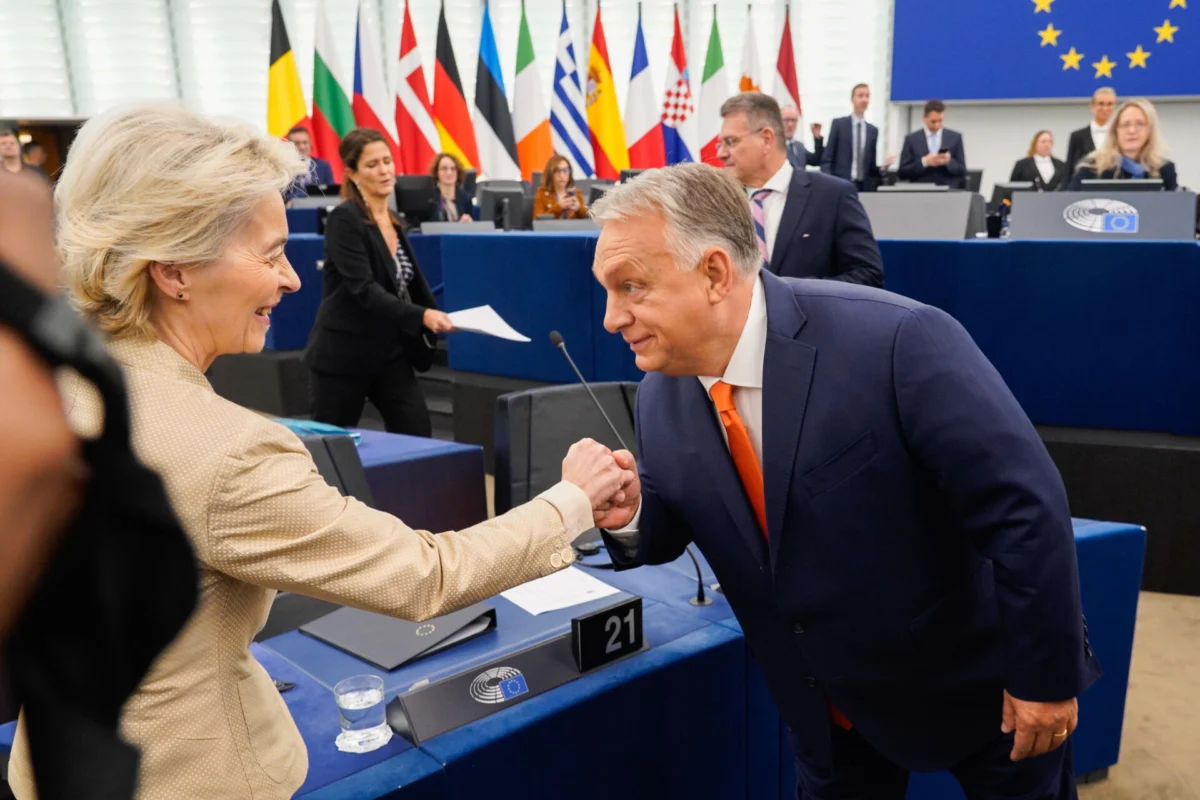
The radical right’s newest paradox is its ideological alignment and quasi-political unity with MAGA, even though parties such as France’s Rassemblement National, or Germany’s AfD were previously intensely critical of US administrations and their influence in Europe.
This hasn’t been smoothed over, as the radical right must often scramble to react to, for example, tariffs or the Greenland crisis. Yet radical-right MEPs will still speak as if there’s no ideological contradiction. There is – but again, it doesn’t matter to them.
The Trump administration is highly convenient for European radical-right parties for two reasons. First, their beliefs about sovereignty and democracy are nearly identical and so their tirades against ‘unelected EU officials’ rhyme well. Second, the Trump administration is a strong material backer – as confirmed by its reported plans to finance ideologically-friendly think tanks across Europe.
This helps radical-right parties in their mission to deconstruct European integration, even at the cost of accepting the very American influence they once denounced.
United in opposition, fragmented once in power?
The radical right’s shift from rejecting the EU to actively seeking to reshape it alongside other radical-right parties is a form of political adaptation. Things may change if they enter government. In opposition, internal contradictions can be managed or deferred – but once struggling for power gives way to exercising power, it’s much harder to avoid tough policy questions.
Giorgia Meloni is a clear example. Despite initially being denounced as the leader of a neofascist party, she became something of a ‘Commission President’s favourite’ after entering office. Her domestic policy shows that her radical-right convictions haven’t disappeared but that the realities of governing have forced her to adopt a more pragmatic approach – including at EU level.
Overall, the radical right should be pleased to eventually enter government, right?
In fact, no. Radical-right ideologues may instead warn against the ‘deradicalisation’ of figures such as Meloni. Whether other radical-right leaders follow Meloni’s example once in power remains to be seen.
What matters now is that these (non-)paradoxes shouldn’t obscure the fact that the radical right has emerged as a powerful political force whose unity – at least for the time being – probably won’t fall apart anytime soon.
The radical right isn’t a passing fad that will eventually peter out. It’s a force that will stick around for some time yet and will undoubtedly leave a lasting mark on the EU’s future.