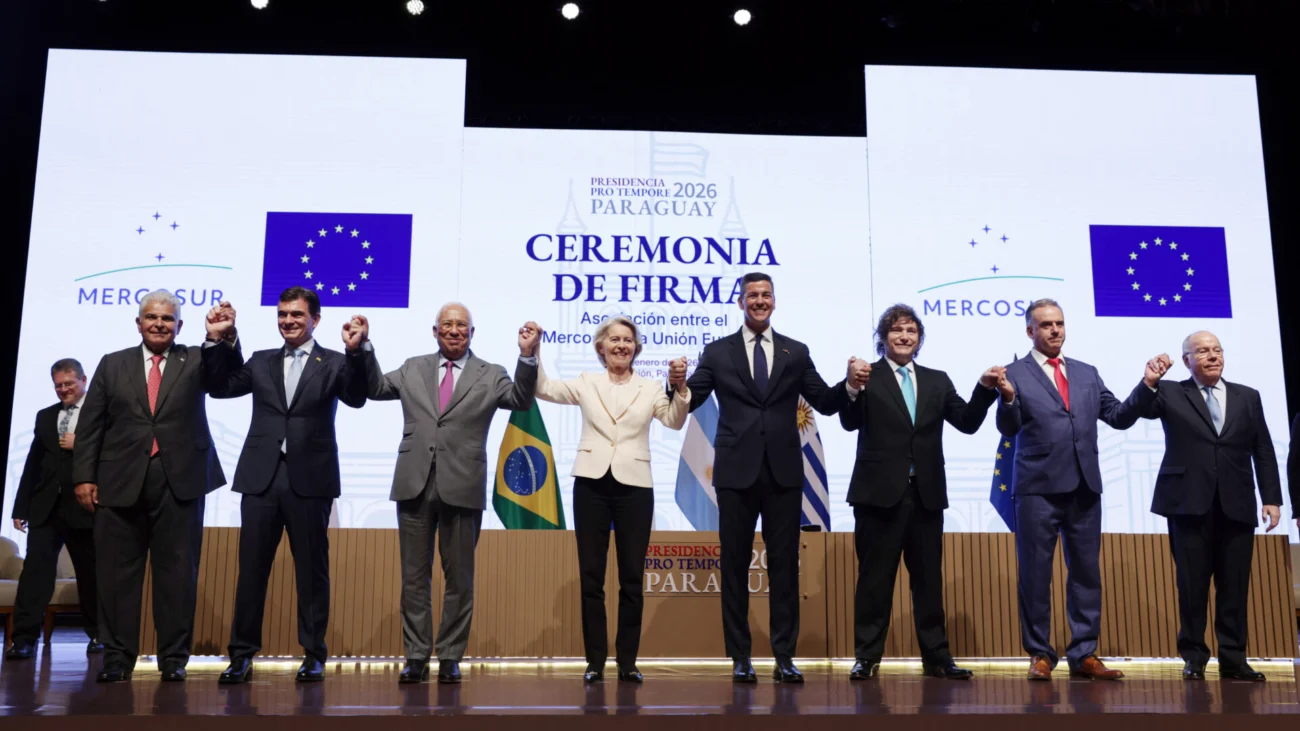

On 1 May 2026, the EU-Mercosur Interim Trade Agreement (iTA) will provisionally come into force, marking a decisive – even if legally incomplete – step in one of the longest-running trade negotiations in modern economic diplomacy.
After more than 25 years of intermittent talks, political setbacks and regulatory recalibration, it’s entering into force in a somewhat paradoxical manner. It follows an agreement between the European Commission and Council on both a full partnership agreement (EMPA) on trade and investment and a temporary trade agreement (iTA), opposition from the European Parliament (EP), its referral to the European Court of Justice (ECJ), and the agreement’s rapid ratification by the Mercosur countries.
While the latter isn’t sufficient for the EMPA to enter fully into force (it must be ratified by all EU Member States), based on the Council’s decision, it does allow the trade component – the iTA – to be provisionally applied.
Consequently, the agreement is now under judicial scrutiny, yet it’s no longer an abstract political commitment: it’s become operational, shaping real economic exchanges. That in itself marks a significant shift.
Mercosur (made up of Argentina, Brazil, Paraguay and Uruguay) represents one of Latin America’s most significant economic blocs and has long been one of the EU’s most important yet under-integrated partners. Trade and investment ties are already deep – the EU is the region’s leading foreign investor and bilateral trade in goods and services was around EUR 150 billion in 2024.
These flows have developed despite substantial tariff and regulatory barriers, particularly on industrial goods and agri-food products.
Economic and strategic benefits
By liberalising more than 90 % of trade, the agreement will create immediate opportunities for EU exporters, especially in sectors such as machinery, automotive, pharmaceuticals and chemicals. These sectors will have improved access to markets that have been traditionally protected by tariffs of up to 35 %, resulting in enhanced competitiveness, expanded market share and new business opportunities.
Equally important is the agreement’s role in strengthening supply chain resilience. The EU has become acutely aware of the risks associated with excessive dependence on a limited number of suppliers, particularly for critical raw materials.
Mercosur offers a credible alternative: a resource-rich region where Europe already has strong institutional, economic and cultural ties. Facilitating trade isn’t just an economic objective but a strategic necessity, with the iTA contributing directly to the EU’s broader agenda of ‘de-risking’ globalisation rather than retreating from it.
The strategic dimension extends beyond economics. The agreement sends a clear signal about the EU’s role in the global trading system. At a time when multilateralism is under strain and protectionist tendencies are re-emerging, the EU is demonstrating its capacity to conclude and implement large-scale, rules-based trade agreements.
In short, alongside ongoing negotiations with partners such as India, Indonesia and Australia, Mercosur is reinforcing the EU’s position as a central actor in shaping global trade governance.
It also carries geopolitical weight. Latin America has become an increasingly competitive arena, with China expanding its economic presence and the US reasserting its influence in the region. Maintaining the EU’s role of primary economic partner requires more than just recognising historical ties; it requires active and visible engagement. The iTA’s application signals exactly this, a move from intent to real, tangible action.
Importantly, the agreement reflects the evolution of EU trade policy towards a more pragmatic approach. The EU hasn’t abandoned its ambitions to promote high standards on issues such as deforestation, carbon emissions and human rights.
But these requirements – often perceived as penalising, particularly by developing and emerging partners – are now being pursued through a more pragmatic balance. Greater flexibility in how and when some conditions are embedded or enforced helps to ensure that regulatory ambition doesn’t prevent the establishment of strategic partnerships.
In this sense, Mercosur may serve as an example of how trade integration can advance regardless of geopolitical tensions and without abandoning the EU’s normative objectives.
Farmers’ protests and politics
Despite these positive elements, the agreement has triggered strong protests from parts of the agricultural sector. Concerns among European farmers have shaped political debates in several Member States and in Brussels.
Ahead of the EP vote, Commission President Ursula von der Leyen proposed mobilising EUR 45 billion from the EU budget to support farmers and secure backing for the deal – but this proved insufficient. The EP instead supported referring the agreement to the ECJ, effectively putting the broader ratification process on hold.
These concerns shouldn’t be dismissed and the democratic process is of course important. Trade agreements inevitably cause various impacts and some of the adjustment pressures in sensitive agricultural sectors are very much real.
Yet the likely impact of competition from Mercosur is often overstated. The agreement includes multiple safeguards for EU farmers, arguably more protective than those granted to Mercosur producers. The liberalisation of sensitive agricultural products is partial and gradual, managed through tariff-rate quotas and accompanied by robust safeguard mechanisms, including the possibility to temporarily suspend preferential treatment if there’s market disruption. Strict sanitary and environmental standards remain in place, ensuring that increased competition doesn’t come at the expense of regulatory integrity.
An often-overlooked point is that trade agreements can actually benefit agriculture. Both the EU-Japan agreement and the provisional application of the Canada-EU (CETA) agreement have seen increased EU agricultural exports. Some of the fears surrounding import surges haven’t materialised. In CETA’s case of, Canada hasn’t flooded the EU market with beef; in fact, it never fully utilised its export quota. This reminds us that how potential risks are politically perceived doesn’t always correspond to actual trade outcomes.
Legal uncertainty – but momentum nonetheless
The legal questions currently before the ECJ should be seen in this broader context. Compatibility with the EU Treaties is a significant issue that should be clarified, but it’s no secret that the process reflects political opposition to EU trade agreements more broadly, often driven by national politics as much as legal concerns.
In this sense, provisional application serves not only an economic function but also a political one: it provides evidence. As benefits become visible – and adjustment costs prove manageable – the debate may gradually shift. Experience often proves far more persuasive than projection.
That’s why even though implementation without full legal certainty isn’t ideal, it may yet prove useful in building the broader democratic support the agreement ultimately needs to succeed.
In this sense, 1 May 2026 isn’t overshadowed by uncertainty – it’s being defined by momentum.