In-person event
Europe’s agricultural landscapes are at a critical turning point. The challenge is no longer whether we can produce food sustainably, but whether food systems can remain viable on a planet that has already warmed by about 1.1°C above pre-industrial levels. We are heading towards far more dangerous projections, with rising risks of crop yield losses and land degradation beyond 1.5°C scenario (IPCC, 2023).
This is a call for society to reconcile productivity with climate resilience, biodiversity restoration, and long-term land stewardship
Agroforestry—the integration of trees into farming systems—offers a transformative, nature-based pathway. It enhances carbon sequestration, strengthens ecosystem services, improves soil health, and diversifies farm income. Yet despite its well-documented benefits, agroforestry remains under-scaled across Europe, covering only about 15.4 million hectares—or 8.8% of the EU’s utilised agricultural area (den Herder et al., 2017).
Why is this the case?
Past CAP programming periods have shown that institutional fragmentation and ‘policy silos’ continue to hinder progress. Agroforestry has often fallen between agricultural and forestry departments, too agricultural for forestry and too forestry-oriented for agriculture. At the same time, farmers considering agroforestry face high upfront costs, long payback periods and limited access to blended or private finance.
We’re at a critical moment, with agroforestry now prominently reflected in National Energy and Climate Plans and Climate Adaptation Strategies, and with the proposed National and Regional Partnership Regulation (2028–34) offering new governance opportunities.
Scaling agroforestry requires more than stated ambition. It requires:
- Regulatory coherence across agricultural, forestry and climate frameworks
- Integrated national and regional planning mechanisms
- Innovative financial instruments that de-risk long-term ecological investments
- Stronger bridges between public incentives and private capital
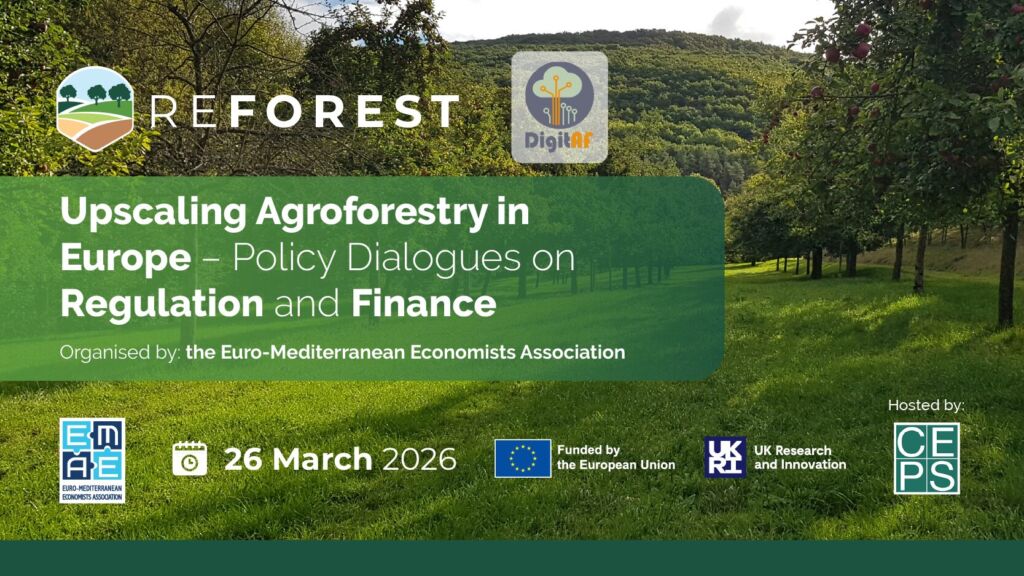
Organised in the Framework of the ReForest and DigitAF projects by the Euro-Mediterranean Economists Association (EMEA) in collaboration with the European Agroforestry Federation (EURAF) and the German Association for Agroforestry (DeFAF) and hosted at the Center for European Policy Studies (CEPS), this Policy Dialogue will bring together policymakers, researchers, financial actors and practitioners to explore how Europe can move from pilot success to the systemic adoption of agroforestry.
The event will feature:
- A brief presentation of the latest research insights and evidence from European agroforestry initiatives from two Horizon Europe projects – ReForest & DigitAF
- A dialogue on leveraging National and Regional Partnership Plans to better integrate agroforestry support
- A dialogue on closing the investment gap and embedding innovative finance mechanisms within the future CAP
By bridging science and policy, regulation and finance, this event aims to help shape a governance and investment ecosystem capable of supporting Europe’s regenerative transition by enabling the upscale of agroforestry practices.
This event will be followed by a networking cocktail.