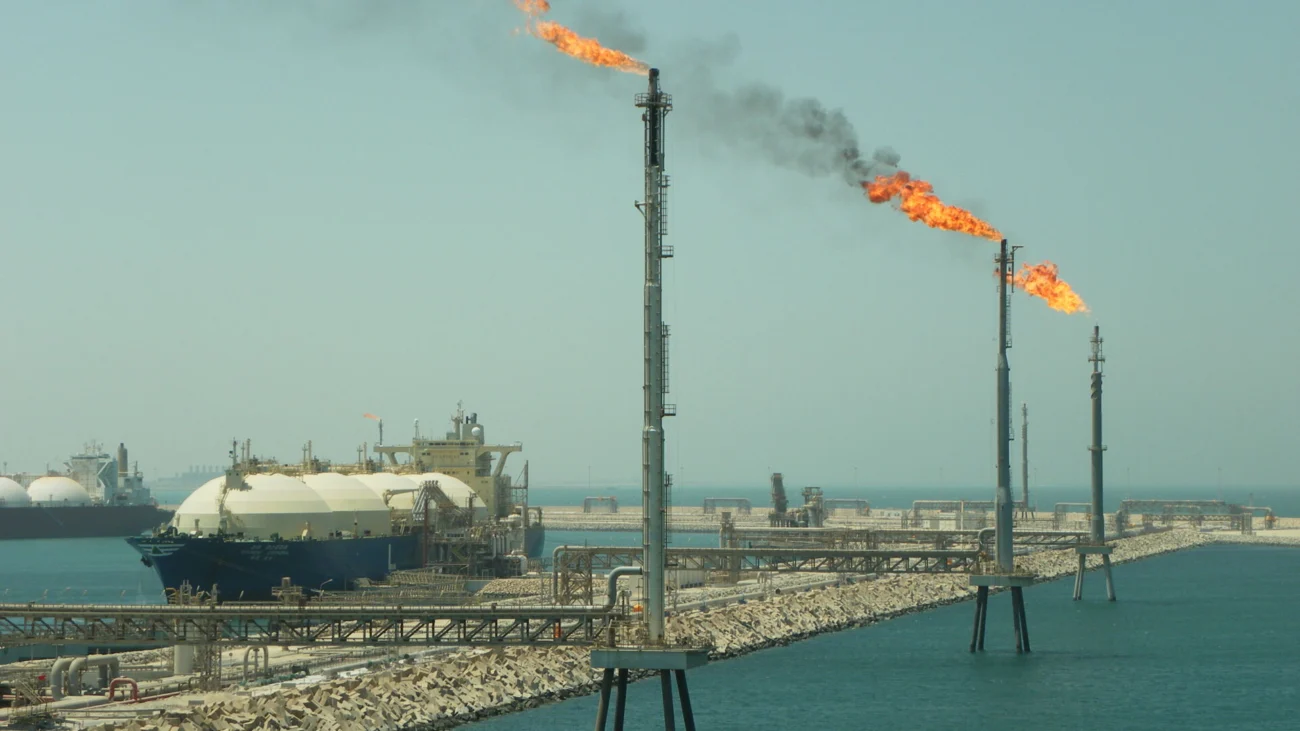

Since 28 February, the closure of the Strait of Hormuz has blocked roughly a fifth of global oil and LNG trade. Qatar Energy declared force majeure on LNG shipments, triggering a fresh spike in gas prices across Asia and Europe.
The Dutch TTF surged 70-100 %, from around EUR 30 MWh to EUR 50-60 MWh. This likely reflects market expectations that the war will be over soon. Equally, the market entered this crisis under relatively soft conditions. Yet if Qatari volumes remain unavailable for longer, the markets could quickly begin pricing in political uncertainty and tighter supply.
Duration is everything, LNG flexibility can hurt
Analysts had long expected a gas glut as new liquefaction capacity was set to come online from 2026. Delays have tightened the outlook. But the overnight removal of roughly a fifth of global LNG supply means there’s no immediate replacement: recently commissioned US terminals and the forthcoming Golden Pass LNG Train 1 won’t fill the gap. Even if the Strait reopens soon, Qatari production cannot restart overnight.
Asia will feel the shock most as Qatar is a core LNG supplier to China, India, Japan, South Korea and especially Bangladesh and Pakistan. Even with a high share of long-term contracts providing some insulation to Asian buyers, replacing Qatari volumes on the spot market is extremely costly – a single redirected cargo could add USD 45 million.
Europe’s direct exposure is lower – about 8% of imports – but price exposure is far more sensitive. Europe enters summer storage refill with inventories well below the five-year average and inverse summer-winter spreads.
Unlike 2022, when soft Asian demand (partly due to China’s zero-Covid policy) helped Europe secure additional LNG, there’s very little spare supply today, thus putting Europe and Asia in direct competition. The upcoming ban on Russian spot LNG from April 2026 may add further tightness. US LNG offtakers could greatly benefit from the crisis. US FOB cargoes are already being redirected to Asia, despite sharply rising freight costs and longer voyages.
Wealthier Asian buyers may outbid Europe, but vulnerable importers will brace for the impact. Oil switching won’t offer much relief either, leaving coal as an immediate alternative for Asia. Prolonged LNG disruption will further hit gas-dependent fertiliser production, with knock-on effects for food security in East Asia.
The possible peril of relying on US LNG
US LNG’s share of EU imports is growing, accounting for about 58 % of LNG imports in 2025 and roughly a quarter of total EU gas imports, causing concerns that Europe may become overreliant on the US.
Yet fears of political disruption are likely overstated – although with the Trump administration one never knows.
First, the rapid expansion of US export capacity is creating strong incentives to secure premium – i.e. European – markets.
Second, geography matters – with most US LNG projects in the Gulf of Mexico, transatlantic shipments are generally more practical and economically attractive, at least while there are still constraints at the Panama Canal.
Finally, US LNG exporters remain commercially driven and were among the first to offer flexible short- and medium-term contracts. Most US LNG bound for the EU are destination-free and can be redirected quickly. Halting US LNG exports to Europe would also likely mean pulling the emergency brake on most current US exports.
However, it’s true that US LNG flexibility results in higher price sensitivity. While some volumes haven been contracted to European utilities, a large share still goes to aggregators with strong price incentives to divert cargoes elsewhere.
Yet longer disruptions to Qatari volumes will only strengthen US exporters’ leverage further. Even though the market was just about to shift in Europe’s favour – after China stopped importing US LNG – at best this window has now been postponed.
If the crisis limits the EU’s leverage, the EU Methane Regulation could become an early casualty. Although some US exporters have indicated their willingness to adapt, the Trump administration is insisting on exemptions until 2035.
LNG’s ‘new normal’
Even if the disruption proves relatively short, the effects could be longer lasting.
LNG has long been seen as politically safer than pipelines, thanks to its inherent flexibility. Yet LNG, advertised as a reliable transition fuel, could now face reputational damage. Supplies, even those considered relatively safe, are becoming increasingly exposed to disruption, and force majeure may also have reputational consequences for Qatar.
All this will encourage buyers to consider alternative suppliers or sources, whether renewables and batteries – or coal.
LNG trade itself is also becoming riskier. Geopolitical, military and security threats have exposed the vulnerabilities of what’s actually a highly concentrated supply chain. Even after the market stabilises, higher insurance premiums and rerouting costs will keep freight expenses high.
Déjà vu for the EU?
While many take comfort that prices remain far below the August 2022 peak, this misses the point: the gas glut probably won’t happen now and high prices are weighing on the EU economy, exposing painful lessons on the gas import portfolio structure.
And of course, gas price spikes intensify political tensions over how to lower energy prices. Structural solutions – electrification, renewables, nuclear, flexibility and grid expansion – are essential but cannot offset short-term shocks. Some immediate solutions discussed include reopening the subsidies and price caps toolbox.
Gas still often sets marginal electricity prices. Some EU Member States are again tempted by the good old idea of ‘decoupling from gas’ and blaming carbon pricing. But even if intervening in marginal prices ultimately creates more problems than it solves, the temptation to slide towards national interventions, ignoring industry calls for regulatory stability and investment certainty, is real.
Similarly, efforts to limit interconnections to protect lower domestic prices could complicate the EU’s push for a more pan-European grid even further.
Industrial sectors, especially those using natural gas as a heat source and feedstock, will be hit most. Temporary state support may offer limited relief, while demand destruction looms again, spurring questions about Europe’s industrial future. The consequences faced by fertiliser production could have knock-on effects on food security and living costs.
Whether the current crisis reopens the Pandora’s box of national interventions is still unclear. What’s clear for now is that the gradual fall of gas prices towards pre-2021 levels over the past two years gave Europe hope of a return to normal. Alas, that hope is now fading.
The author thanks Anne-Sophie Corbeau for providing comments on an earlier version of this commentary. All mistakes, opinions and omissions remain solely those of the author.